A genuine website-platform deal is not simply the largest percentage-off label. It is an offer you can check before paying: the introductory price, commitment length, included services, renewal scenario, cancellation terms and practical limits should all be clear enough to save and compare. For a UK small business, that makes it easier to choose a platform that fits both today’s budget and the site you intend to run.
What a genuine website-platform deal looks like
A deal is genuinely useful when its important terms are visible before checkout, rather than being left to assumptions. Start with five basics: what you pay now, how long you are committing for, what the plan includes, what may change later and what happens if you need to cancel.
This matters because a low advertised monthly figure can be tied to a much longer subscription. The right question is therefore not “How big is the discount?” but “What am I buying, for how long, and what will it cost over the period I expect to use it?”
For an online business, clarity is also part of good purchasing practice. UK guidance says distance sellers must provide specified pre-contract information, including payment, contract length and cancellation conditions, in a form customers can save. Use the same standard when evaluating a platform provider: if you cannot locate, understand and retain the key offer terms, you cannot make a like-for-like comparison with confidence.
Compare hosting plans using the same fields before choosing a provider.
Read the offer duration and included features together
Write down the advertised price next to the required subscription length. Do not treat a promotional rate attached to a 48-month commitment as though it were a flexible month-to-month price. A longer term may suit a stable project, but it changes both the upfront commitment and the comparison with a shorter plan.
Then list what is included at the plan level. The supplied Hostinger UK plan information, for example, shows that plan coverage can differ for websites, storage, backup frequency, domains and mailboxes. Its Premium plan lists a domain and two mailboxes per website as free for one year, while its Unlimited plan lists daily backups and unlimited mailboxes per website free for one year. Those details are useful only when read alongside the selected plan and subscription term.
Separate first-year benefits from continuing operating costs. A “free domain” or “free mailbox” can be valuable, but record its stated period and check the published renewal terms before treating it as a permanent inclusion. Do the same for storage, number of sites, backup frequency, CDN access, ecommerce tools and support level.
Finally, match features to the work your site will actually do. A brochure site may have different needs from a store, membership site or agency portfolio. Confirm that the stated site limit, storage, recovery options and support level are sufficient for your intended workload—not merely present somewhere in a feature list.
Use a website-hosting features checklist and understand domain renewal costs before checkout.
Spot the conditions behind the headline discount
The most important conditions are often the ones a headline price does not explain. Check whether the promotion depends on a particular commitment length, whether benefits apply to every plan and whether they last for the whole contract or only a stated period.
Do not assume a feature is unlimited, permanent or appropriate for every use case because it is mentioned on a product page. For example, the supplied Hostinger UK page distinguishes between weekly, daily and daily-on-demand backups across plans, and it describes some domain and mailbox benefits as free for one year. That is a reminder to compare the exact plan wording rather than general marketing language.
Look for gaps as carefully as you look for inclusions. Can you find the renewal price or the route to it? Are the cancellation and money-back terms easy to locate? Is the plan’s support level identified? Are any essential services—such as migration assistance, extra mailboxes, longer retention or higher capacity—outside the advertised package?
A condition is not automatically a reason to reject an offer. It is a reason to price and assess it properly. If a term is unclear, difficult to save or missing from the material you can access, treat the comparison as incomplete until the provider clarifies it.
Read renewal terms before comparing hosting offers.
Calculate the real cost before calling it a saving
AI-generated generic editorial illustration — not a retailer product photo and does not depict the reviewed product or service. Give readers a visual method to calculate the total commitment cost before judging a headline discount.
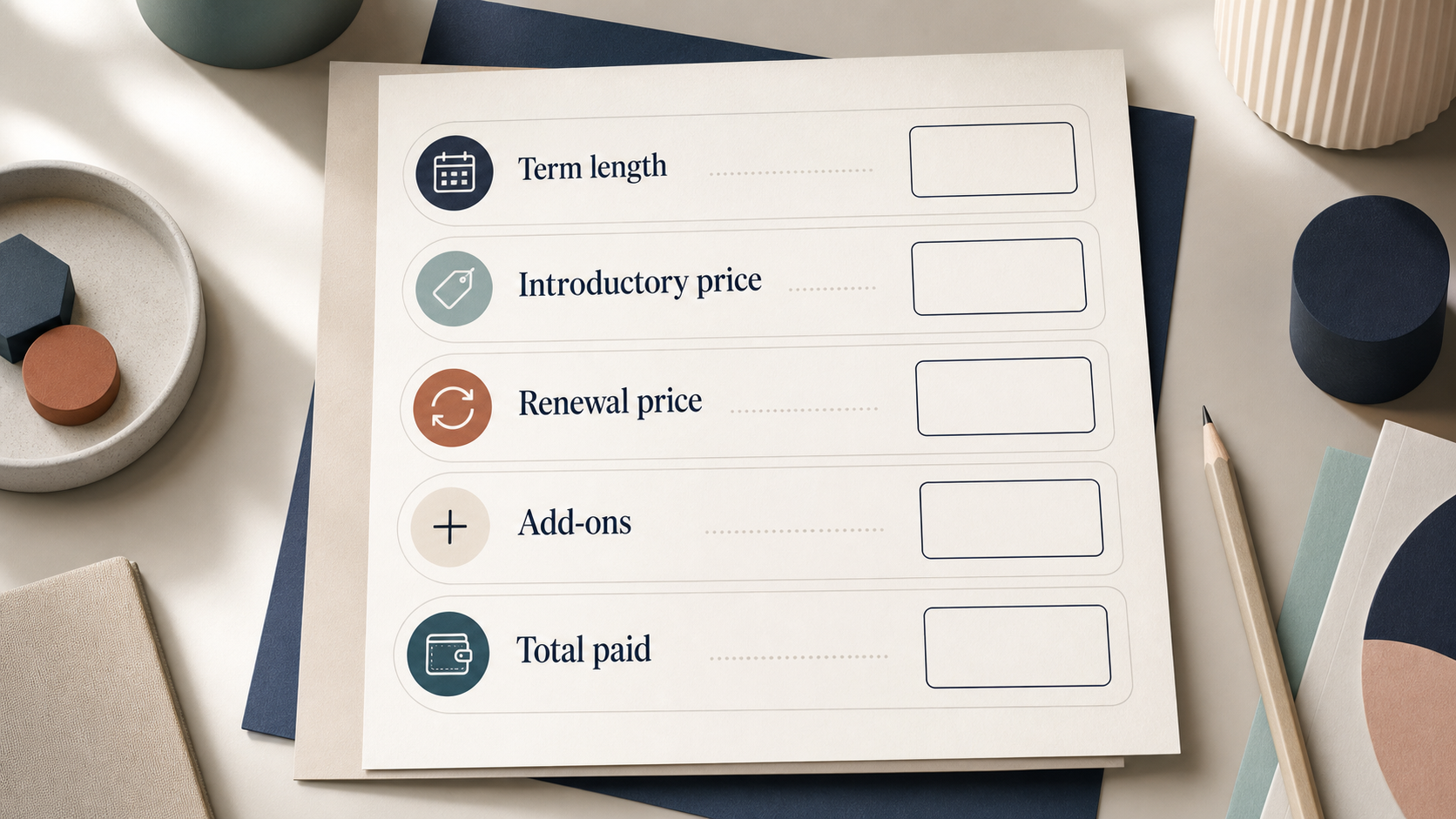 Use a five-input worksheet before judging value:
- Initial term: multiply the promotional price by the required commitment and include any upfront payment.
- Renewal period: identify the published renewal scenario for the period you expect to keep the service after the promotion.
- Domain and email continuation: record when introductory domain or mailbox benefits end and what you would need to pay to continue them.
- Add-ons and operations: include backups, migration help, additional capacity, security services or support options that your planned site needs.
- Total paid: add the amounts for the realistic period of use, then compare providers on that total rather than their percentage-off labels.
This does not require forecasting every possible future expense. It requires separating the initial outlay from the expected cost of operating the site. If you plan to use a service for several years, a deal with the lowest first payment is not necessarily the lowest-cost choice over that timeframe.
Keep a dated record before paying: screenshots or saved copies of the offer, plan inclusions, selected term, relevant renewal information and cancellation terms. These records make later comparisons easier and give your team a shared reference for what was available when the purchase decision was made.
Start with a small-business website budget template and enter the same five inputs for every shortlisted plan.
Check the consumer-information and cancellation implications
If you are choosing a platform for an online shop, the decision is about more than hosting features. You also need a practical way to provide customers with the information required for online selling.
UK government guidance says that, before an order is placed, distance sellers must provide information including their business name and contact details, a description of goods or services, payment and delivery arrangements, the minimum contract length and billing period, and conditions for ending or cancelling contracts. The information must be easy to understand and provided in a form the customer can save.
The same guidance explains that online customers can have cancellation rights in specified circumstances, with different rules for downloads and streaming services. Separate government guidance also states that online, mail and telephone customers can generally cancel within 14 days of receiving an item, subject to applicable exceptions and conditions. A business should not use platform choice as a substitute for understanding its own legal obligations.
When comparing website builders or hosting, ask whether you can publish clear contact, delivery, cancellation and returns information, send appropriate communications and maintain the pages your business needs. The answer will vary with what you sell and how you fulfil it. Obtain suitable advice for your own arrangements where needed, especially for digital content, services, subscriptions or cross-border sales.
Review UK online-selling compliance alongside an ecommerce returns-policy checklist.
Use a five-step deal-verification checklist
Use this sequence for each shortlisted platform:
- Capture the offer. Save the price, selected plan, commitment length and the date you viewed it.
- Verify inclusions. Check the exact coverage for domains, email, SSL, backups, storage, websites, support and any tools your site requires.
- Price the continuation scenario. Record what changes after introductory periods and add foreseeable operating extras.
- Confirm operational fit. Check support, migration, recovery and capacity against your planned site—not against an idealised future upgrade.
- Read cancellation and refund terms. Save the provider terms, then make sure your own online-selling setup can present required customer information.
Proceed when you can answer each of those questions from published material you have retained. If you cannot, ask the provider or leave the plan off the shortlist until the missing point is resolved.
Comparing two or three providers with the same worksheet is usually more useful than comparing their promotional percentages. It keeps the choice focused on total commitment, useful features and the operational consequences of the plan.
Compare website builders and plan a potential hosting move using the same checklist.
Frequently Asked Questions
Are website-builder and hosting discounts always available for the same subscription length?
No assumption is safe here. Promotional pricing can be connected to a specific selected term. The supplied Hostinger UK page, for example, presents a subscription-length selector and shows a 48-month selection in its plan material. Check the exact term displayed with the price you intend to buy, save it and compare it with any shorter option before deciding.
How can I tell whether a free domain or email service is included only for the first year?
Read the inclusion next to the specific plan, not only the page headline. The supplied Hostinger UK information expressly describes certain domain and mailbox benefits as free for one year on named plans. If a duration is not clear in the published plan details or terms, ask the provider before counting that service in your longer-term budget.
What should I check about renewals before I buy a discounted hosting plan?
Identify the initial commitment, find the applicable renewal information, and include domain, email and required add-ons in a realistic continuation budget. Retain the relevant plan and terms pages. A low introductory payment is only one part of the cost of running the site for the period you intend to use it.
What cancellation and refund information should an online business give its customers in the UK?
Government guidance says online sellers must provide key pre-contract information in a clear, savable form, including contract and cancellation information. Customers buying online may have cancellation and refund rights in stated circumstances; government guidance highlights a 14-day cancellation period for many distance sales of goods, subject to conditions and exceptions. Check the official guidance against your particular goods, services or digital content, and obtain suitable advice where necessary.
Before you buy: complete the five-step checklist for your shortlisted plans and keep the terms you used to make the decision.
Sources
Related reading
- Best website builders and web hosting for UK small businesses: evidence-led choices
- Squarespace review: practical website-builder assessment for UK creators
- How to choose a website builder or web host for your needs
- When website-builder and web-hosting plans offer better long-term value
Editorial information: About our editorial team · Read our editorial policy · Read our affiliate disclosure.